
The mirror of attention: which elements of the SERP are viewed but not clicked on
[EYE TRACKING STUDY]
The mirror of attention: Attention is a vanity metric. Just because a SERP element is looked at does not mean it works. In this eye-tracking study, we measured the attention-to-action gap for each element: the difference between how many people look at it and how many click on it. The results paint a clear picture of the elements that convert attention into clicks and the ‘black holes’ that absorb it without giving anything back. SERP elements are looked at but not clicked on
Table of Contents
TL;DR: Click here to read the conclusions
Methodology
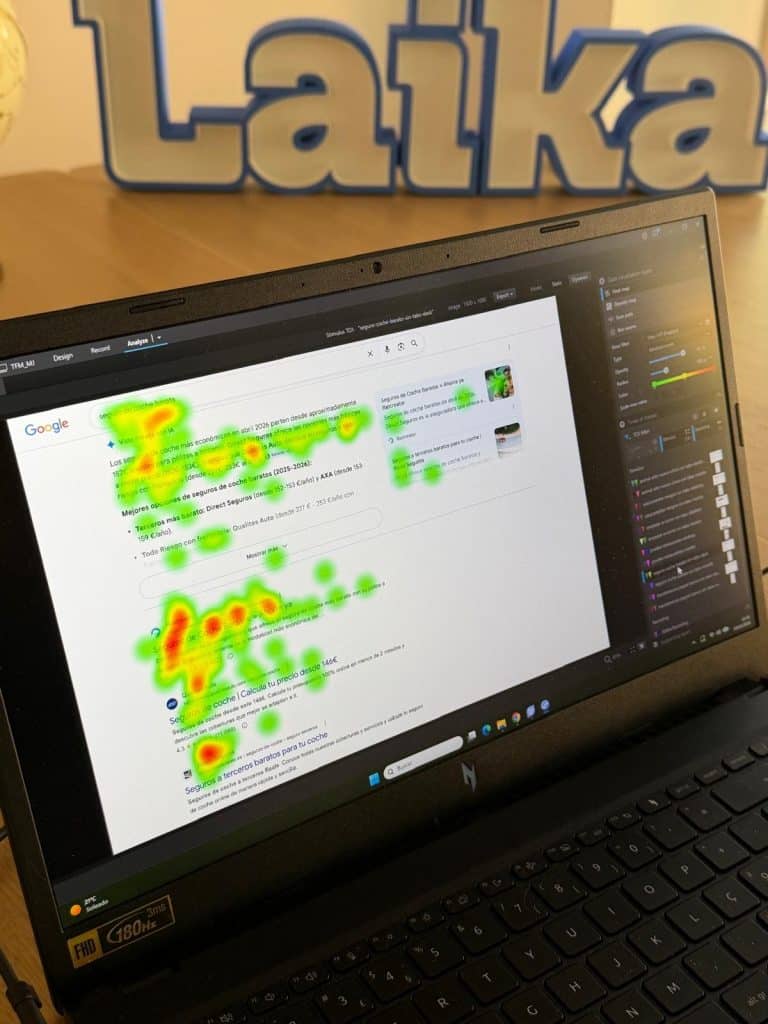
Every element on a results page competes for two different user resources: their attention and their click. We usually measure only the latter through CTR or infer it from the position.
Eye-tracking allows us to measure both separately and, above all, the difference between them: how much attention an element captures that never translates into action.
We define the key metric for this study:
Attention-Action Gap = Engagement (% of viewers) − CTR (% of clicks).
A high gap indicates passive engagement, which means that the element is viewed frequently but rarely clicked.
A low gap indicates an effective element: almost all of the user’s attention results in a click.
Objectives
- Quantify engagement and CTR separately for each category of SERP element.
- Calculate the attention-action gap and rank the items from most to least “passive.”
- Characterize the depth of processing (average fixation, first glance) of the elements with the largest gaps.
- Within the AI Overview, identify which subcomponents perform conversions and which ones are merely decorative.
Limitations
- Limited sample size(22 participants): The percentages for categories with small sample sizes (Images N=6, PAS N=10) should be interpreted with caution.
- Free navigation: Not all participants saw the same elements; all metrics are calculated only for those who had the element displayed (Shown = 1).
- Clicks without prior fixation: Some buttons (e.g., “Show More” in the AIO) register reflexive clicks without prior fixation on their AOI, which can result in an apparent negative gap. We note this wherever it occurs.
- Observational, non-experimental design: identifies associations, not causation.
- Depth metrics are calculated only for participants who looked at the element.
The conclusions should be interpreted with these limitations in mind.
Tools and Data
- Device: Tobii Pro desktop eye tracker, mounted on a monitor. Testing conducted under controlled laboratory conditions.
- Country and language: Spain. Searches conducted on a desktop computer, on Google.com, in Spanish.
- Data collected between December (2025) and February (2026)
- Processing: Python (pandas), cross-tabulation of metrics × visibility, base Shown = 1.
- Visualization: Chart.js / R.
Summary of the Data Used
- 22 unique participants
- 9 searches · 4 intents
- 1,556 data points (participant × AOI shown)
- 15 categories of SERP elements analyzed
Glossary of the Most Viewed or Clicked Items
The following table shows the main elements that have emerged during the study
| Element | What is it? |
| AIO Main | The AI-generated answer block that Google displays at the very top (before you click “show more” and it expands) |
| AIO Links | Sources cited within the AIO (links to websites) |
| AIO Explore Further | The “Explore Further with AI” button to expand the answer |
| AIO · Other Blocks | Heterogeneous aggregate of AIO subcomponents |
| Organic | Classic search results (the traditional “blue” links) |
| Sponsored | Text ads (Google Ads) above or below the search results |
| Shopping | The sponsored products section, featuring a photo, price, and store |
| Product Pages | Organic (unpaid) product listings |
| PAA (People Also Ask) | The drop-down block titled “Other User Questions” |
| PAS (People Also Search) | Related search suggestions at the bottom |
| Related (chips) | “Pills” or related search tags |
| Knowledge Graph | The knowledge panel with summary data about an entity |
| Images | The image block or carousel |
| Videos | The video section |
Summary of the Data Used
unique participants
searches
data points
categories
Is Looking the Same as Clicking? The Great Disconnect Between Attention and Action
Key Points
- Attention and clicks are decoupled: elements with nearly identical engagement rates (95–100%) have CTRs ranging from 95% to 0%.
- Organic traffic is the only source that captures nearly all of the attention (gap of 4.5 pp), compared to images and product listings, which capture 100% of the attention but receive 0 clicks (gap of 100 pp).
Key 1: Same engagement, opposite CTRs
Images, product listings, PAA, and sponsored posts all share a 100% engagement rate—they all get viewed. But their CTR ranges from 50% for PAA to 0% for images and product listings. Attention alone does not predict anything.

Each point represents a category of element. The diagonal line marks the perfect conversion (click = attention); the lower a point falls, the greater the illusion of attention it creates.
Key 2: The gap as a compass
Sorted by the attention-to-action gap, the elements are divided into three categories: converters (gap < 30), the intermediate zone (30–60), and “mirage” (gap ≥ 60), where attention is almost completely wasted.
|
Element |
N |
Engagement |
CTR |
Gap (pp) |
|
Images |
6 |
100,0% |
0,0% |
100,0 |
|
Products |
16 |
100,0% |
0,0% |
100,0 |
|
AIO: Explore Further |
18 |
83,3% |
0,0% |
83,3 |
|
PAS (related searches) |
10 |
90,0% |
10,0% |
80,0 |
|
Videos |
20 |
95,0% |
20,0% |
75,0 |
|
AIO Links |
22 |
81,8% |
13,6% |
68,2 |
|
Sponsored |
20 |
100,0% |
45,0% |
55,0 |
|
Related (chips) |
22 |
72,7% |
18,2% |
54,5 |
|
PAA |
22 |
100,0% |
50,0% |
50,0 |
|
AIO Others |
14 |
85,7% |
35,7% |
50,0 |
|
AI Mode (Barcelona) |
22 |
100,0% |
59,1% |
40,9 |
|
Knowledge Graph |
18 |
44,4% |
5,6% |
38,8 |
|
AIO Main |
22 |
100,0% |
86,4% |
13,6 |
|
Organic |
22 |
100,0% |
95,5% |
4,5 |
SERP in Three Families
If we group the 14 elements based on their attention-to-action gap, the results page is organized into three distinct, clearly defined blocks:
|
Block |
Gap |
Elements Involved |
|
Converters |
< 30 |
Organic (4.5) · AIO Main (13.6) |
|
Intermediate zone |
30–60 |
Knowledge Graph (38.8) · AI Mode (40.9) · PAA (50) · AIO Others (50) · Related Chips (54.5) · Sponsored (55) |
|
Illusions |
≥ 60 |
AIO Links (68.2) · Videos (75) · PAS (80) · AIO Explore Further (83.3) · Images (100) · Product Sheets (100) |
Key 3: Attention is a vanity metric
Optimizing to “get noticed” (position, size, color) can inflate engagement without driving clicks. The gap is the metric that really matters: it measures whether attention is being monetized or wasted.

Black holes of attention: you look at them but don’t click on them
Key Points
- Six elements account for the loss of attention: images, product cards, AIO Explore Further, PAS, videos, and AIO Links—all with a gap of ≥ 68 pp.
- Not only are they not clicked on—they aren’t even read. Their average dwell time (256–561 ms) falls within the range of quick scanning, not reading.
Key 1: They catch the eye, but fail to get the click
The most extreme example is AIO Explore Further: 83% of those who see it look at it, but not a single one clicks on it. The images and product listings follow the same pattern: 100% attention, zero conversion.

Engagement vs. CTR for the six elements with the largest gap. The light bar (attention) is two to three times higher than the dark bar (click).
The six elements that waste the most attention are, in order of gap: images and product listings (100% attention, 0% clicks), AIO Explore Further (83% view it, no one clicks on it), PAS (90% / 10%), videos (95% / 20%), and AIO Links (82% / 14%). All have a gap of 68 points or more: they catch the eye but fail to drive action.
Key 2: Superficial attention, not reading
The average fixation duration for these elements indicates scanning, not reading: Images 279 ms, AIO Explore Further 256 ms, PAS 292 ms. Below ~600 ms, the user barely processes content; they only recognize shapes. The eye glances over them and moves on.
Key 3: Opportunity Cost in the SERP
These blocks take up prime real estate and draw attention, but they don’t generate traffic for either Google or the websites. From an SEO perspective, competing to appear in them (e.g., in videos or images) yields few clicks; their value lies in branding or visibility, not in driving traffic.
Efficient Converters: When Viewing Does Lead to a Click
Key Points
- Organic and AIO Main are the only true converters: a gap of 4.5 and 13.6 pp. Almost all of their traffic results in a click.
- They convert because they are read, not just looked at: their average fixation time (627 and 919 ms) falls within the range for comprehensive reading.
Key 1: Organic Search—The King of Conversion
The organic result has the smallest gap on the entire SERP: 100% engagement and a 95.5% CTR. It remains the natural destination for user action, despite all the competition from new elements.

Only two elements convert nearly all the attention they receive: organic (100% engagement, 95.5% CTR) and AIO Main (100% / 86.4%). Below that, the rest lose half or more: AI Mode (59.1%), PAA (50%), and Sponsored (45%) generate a fair amount of clicks, but leave a lot of attention unconverted.
What about people who don’t see each other very often but hook up a lot?
Here’s a finding in and of itself: that quadrant is practically empty. No result combines low engagement with a high CTR. The two that convert the most—organic and AIO Main—are seen by 100% of those who see them. On this SERP, attention is a prerequisite for a click: nothing gets clicked very often without being looked at first.
The only exception is the “show more” button on the AIO, which has a CTR (86%) higher than its engagement rate (77%). But this isn’t a hidden shortcut: it’s the reflexive click we detailed in the limitations section. Far from being an opportunity, this confirms that blind CTR is misleading.
Key 2: Depth = Conversion
The pattern is consistent: the elements that convert are the ones that are read. AIO Main (919 ms average fixation time) and Organic (627 ms) receive in-depth processing; the “black holes” from the previous section get only a quick glance. Reading depth is the best predictor of a click.
Key 3: The PAA and AI Mode: In No Man’s Land
PAA (gap 50) and IA mode (gap 41) fall into the middle range: they generate a fair amount of clicks (50% and 59%), but leave a lot of user attention unconverted. They serve as exploration tools: users use them to get their bearings before deciding where to click.
Inside AI Overviews: A conversion core and passive satellites
Key Points
-
The AIO is not a homogeneous unit: its core (AIO Main) achieves 86% efficiency, but its satellites drop to 36%, 14%, and 0%.
-
“Explore Further with AI” is just for show in terms of engagement: 83% view it, 0% click on it.
Key 1: The core is in charge
All of the AIO’s call-to-action value lies in its main block: AIO Main converts at a rate of 86.4%. Surrounding it, the links (AIO Links, 13.6%) and the “Learn More with AI” button (0%) capture attention but do not drive action.

Engagement and CTR of the AIO subcomponents. Only the main block converts attention into clicks.
The most telling statistic: no one switches to AI Mode
“Explore Further with AI” is the gateway Google has designed to take users from the SERP to AI Mode. In our study, 83% of those who saw it looked at it, and none (0%) clicked on it. If that’s Google’s main strategy for driving traffic to AI Mode, our data suggests that almost no one deliberately clicks on it from the search results.
Time-sensitive note: We collected the data before Google changed the access (today, “show more” can take you directly to AI Mode). Even so, the underlying insight remains the same: deliberate entry into AI Mode from the SERP is rare.
Keep in mind that the “drill down” layer is only accessible once AI Overviews has been expanded, and there will be a button within it to continue drilling down; that is, you can drill down after clicking the second button a second time. The following image shows the different areas of interest in the SERP that we’ve analyzed:

Key 2: Satellites Dilute Attention
The links and options surrounding the AIO distract the user’s attention without generating clicks. From the user’s perspective, they are noise; from an SEO perspective, appearing as a link cited within the AIO generates visibility but results in a very low CTR (13.6%).
Key 3: A revealing anomaly
The “show more” button on the AIO exhibits an apparent negative gap (CTR 86% >, engagement 77%): it is clicked reflexively, sometimes without any prior eye contact with that area. This is proof that some clicks on the SERP are automatic, not deliberate—an important nuance to consider when interpreting any CTR.
On the SERP, attention and clicks are two distinct economies. There are elements that command attention but never generate clicks—images, product listings, “Explore with AI”: they’re viewed 100% of the time but don’t get a single click. And there are a handful of true converters—organic results and the AIO hub—that convert because they’re read, not just viewed. The attention-to-action gap—not engagement—is the metric that separates what works from what’s merely decorative.
Recommendations and Next Steps
Next Steps
- Compare the search intent to see if the same item is more passive depending on the type of query.
- Model clicks based on reading depth (average fixation) per participant.
- Distinguish between deliberate clicks and reflex clicks using the fixation→click sequence.
- Expand the scope of small-n categories (images, PAS, knowledge graph).
SEO Recommendations Based on the Study
- Stop stressing out about ranking for images and product listings: 100% of people look at them, but 0% click on them. Their value lies in brand awareness and visibility, not in traffic.
- Organic traffic remains king when it comes to clicks (95.5%): traditional SEO is the most effective way to turn attention into visits, despite the noise from new elements.
- If you’re featured, make sure it’s within the AIO core: AIO Main converts at 86%, but appearing only as a satellite link (AIO Links) provides visibility with a CTR of just 13.6%.
- Videos and PAS: high opportunity cost, low return—they take up prime real estate and draw the eye, but barely generate any clicks. Compete there for visibility, not by waiting for traffic.
- PAA and IA Mode are for exploration, not a destination: with average CTRs (50% and 59%), users use them to get their bearings before deciding where to click.
- Don’t just look at the CTR blindly: some clicks (“show more”) are reflexive and inflate the CTR without any real intent.
Authors

Diego Criado
I am passionate about digital marketing and data science, with a special focus on consumer psychology. I have held key data analytics positions at companies such as Telefónica and KPMG, where I learned the importance of data and analytics in marketing. In addition, I have shared my experiences as a professor at EAE Business School and KSchool, preparing students for the challenges of digital marketing.
With a background in data science and a deep interest in consumer psychology, I am interested in exploring how an understanding of the human brain can enrich and transform our marketing strategies in the digital age.

MJ Cachón
With a degree in Business Administration and Management, training in UX, Product Design, Business Intelligence, and Neuromarketing, and extensive experience in SEO across multiple industries, I’ve helped hundreds of websites identify their issues and unlock their potential with the most efficient solutions. I’m passionate and enthusiastic about data—I used to analyze it with R, and now I use Python and AI-powered processes. In addition to leading Laika, I’m one of the founders of #MujeresEnSEO and also co-direct the SEO Master’s program at Webpositer Academy.
TL;DR: Findings on the impact of the attention-click gap
- “ATTENTION” AND “CLICK” ARE UNLINKED
Same engagement rate (95–100%), CTR ranging from 0% to 95%. Viewing doesn’t predict clicking.
- THE CARE-ACTION GAP IS THE COMPASS
Classify the elements into converters (gap <30), intermediates (30–60), and mirages (≥60).
- SIX “BLACK HOLES” IN HEALTH CARE
Images, product sheets, AIO Explore Further, PAS, videos, and AIO Links: gap ≥ 68 pp.
- NO ONE EVEN READS THOSE NONSENSE ARTICLES
Average fixation duration of 256–561 ms: scanning, not comprehensive reading.
- JUST TWO REAL CONVERTERS
Organic (gap 4.5) and AIO Main (gap 13.6). They are compelling because they are read thoroughly.
- THE AIO IS NOT HOMOGENEOUS
Its core accounts for 86%; its satellites (links, Explore Further) account for 14% and 0%.
- BE CAREFUL WITH THE CTR
Some clicks (“show more”) are reflexive, not deliberate: they inflate the CTR without any real intention.
Would you like to stay up to date on our future studies?
Let’s continue the conversation on social media—be the first to find out about upcoming studies and publications on SEO.
Thank you for being part of the LAIKA community.